The Precision Problem
Picture this: You’re the Plant Manager at a precision manufacturing company. Six production cells running complex work orders. Engineers designing custom solutions. And when a customer asks “How much will this cost?"—you’re quoting based on jobs from three years ago.
That was Houston Co’s reality.
They’d built a reputation for quality and precision. But their reporting was anything but precise. Shop floor data lived in one system. Engineering hours in another. Material costs that were “estimated” at quote time and never reconciled to actuals. And a sales team making promises based on margins that existed only on paper.
They were stuck.
Our quotes were basically educated guesses. Sometimes we’d win a job and lose money. Sometimes we’d lose a job we could have won.
That’s the kind of uncertainty we walked into. This wasn’t about dashboards. This was about the fundamental economics of the business.
The Problem Beneath the Surface
When we sat down with Patricia from Finance and Miguel from Engineering, the scope of the challenge became clear. It wasn’t just about tracking costs. The problems ran deep:
The Work Order Nightmare
- Labor hours tracked on paper and entered days later
- Material consumption estimated rather than actual
- Engineering changes that weren't reflected in job costs
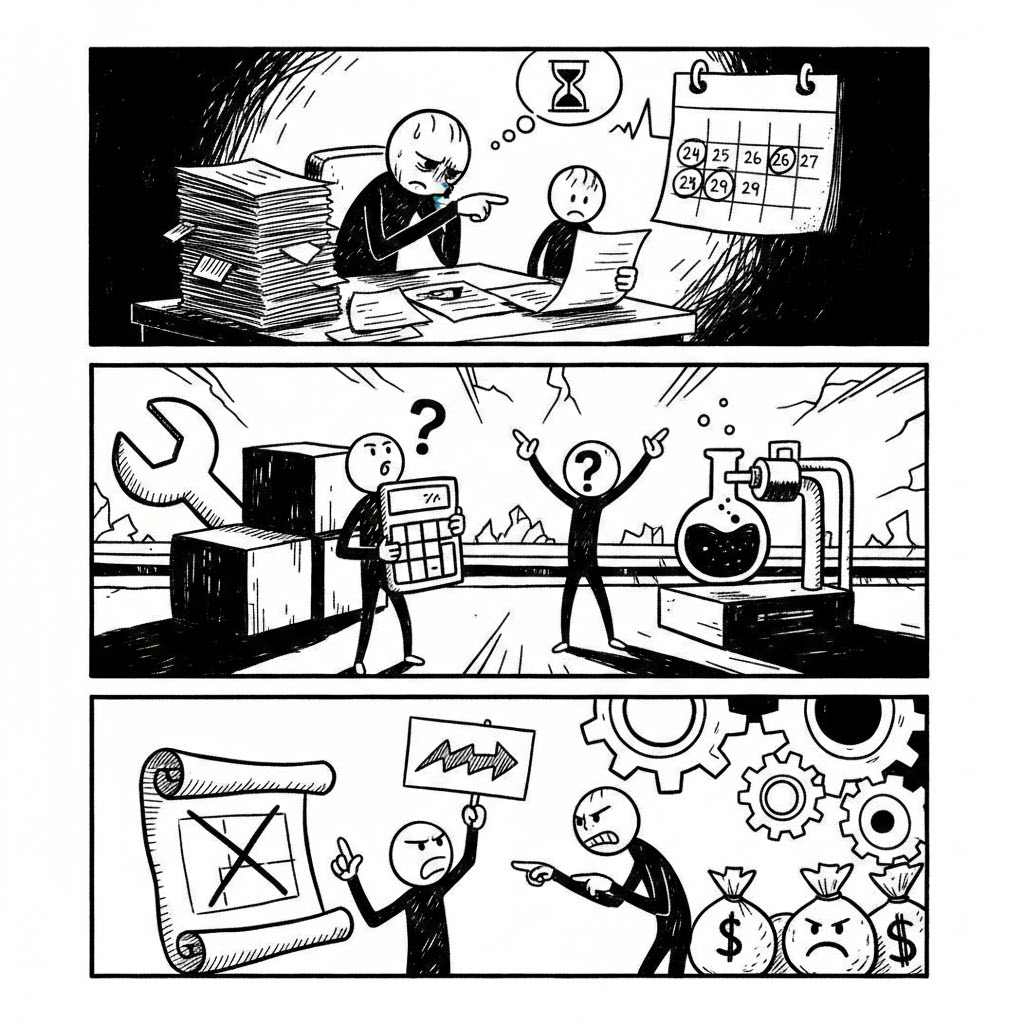
The Quoting Maze
- Historical job data that was incomplete or inaccurate
- No way to compare quoted vs. actual by job type
- Customer-specific requirements that weren’t factored into estimates
The Capacity Dilemma
- Production cells with different capabilities and rates
- No visibility into actual utilization vs. planned
- Bottlenecks that weren’t identified until jobs were late
As Patricia put it: “We close the books every month. But we don’t really know if we made money on any specific job until months later—if ever.”
The existing system just wasn’t built for this complexity.
Enter the Creators
This is where Bish and Bhavana stepped in.
Their approach wasn't to throw technology at the problem. It was to understand it first. Hours of calls. Shop floor walks. Questions like "What happens when an engineer makes a change mid-job?" and "Walk me through how you quote a new customer."
The Key Insight
The breakthrough came when we realized the core issue: Houston Co didn't need more reports. They needed connected reports, linking quotes to actuals, delivered while jobs were still in progress.
Bhavana proposed a three-pronged approach:
- Real-Time Job Costing tracking labor, material, and overhead as work progresses
- Quote vs. Actual Analysis to improve future estimates
- Capacity Visibility showing utilization by production cell
No more waiting until month-end to know if a job was profitable.


The Proposed Solution
We invoked the 5 Standards of the Report Factory:
1. ETL Plumbing
Solidifying the data pipeline from D365 F&O to Microsoft Fabric. Shop floor data, engineering hours, and financial transactions—all flowing together.
2. Data Modeling
A single source of truth. One data model that connected work orders to financial outcomes. We built custom views to track costs at the operation level within each job.
3. Visual Hierarchy
Flyovers for executives who need margin summaries. Drill-downs for production managers who need job-level details. Everyone sees what they need to see.
4. Maintenance
Systems that can be managed even if outsourced. Documentation. Standards. Repeatability. No platform lock-in.
5. Portability
Architecture that can be moved between platforms without losing functionality.
The Transformation
We caught a job going sideways in week two instead of finding out at month-end. Saved us $40K on that one job alone.
Here’s what changed:
Before:
- 6 production cells, 6 different tracking methods
- Job profitability known months after completion
- Quotes based on outdated historical data
- No visibility into work-in-progress costs
After:
- Real-time job cost tracking across all cells
- Quote vs. actual analysis improving estimate accuracy
- WIP visibility enabling mid-job corrections
- Capacity utilization driving better scheduling
The moment of truth came when they caught a complex job heading toward a loss in week two of a six-week project. Miguel’s reaction?
“Before, we would have finished that job, invoiced it, and wondered why our margins were down. Now we saw it coming and made adjustments.”
That’s the sound of precision extending beyond the shop floor.
The Bigger Picture
What Houston Co taught us goes beyond reporting. It’s about the future of how manufacturers operate.
As Joe shared during one of our sessions:
I don’t think there’s going to be a reporting department in the future. What’s going to happen is that people will write an operating system that runs the business. And reporting is just for the AI agents, it’s just for the operating system.
The materiality of stopping and thinking—of pausing to look at printouts and decide what to do—is a massive cost to any organization. Houston Co’s transformation is a step toward a future where the right information flows to the right decisions automatically.
Your Turn
Houston Co’s journey from stuck to unstuck took weeks, not months. The investment was measured in thousands, not hundreds of thousands.
Every organization has a story. What’s yours?
Are you:
- Quoting jobs without knowing true costs?
- Finding out about margin problems after it’s too late?
- Struggling to connect shop floor data to financial outcomes?
The water might be rising. But you don’t have to stay stuck.